
30 June 2023

Treble simulation of diffraction (RS6)

Abstract

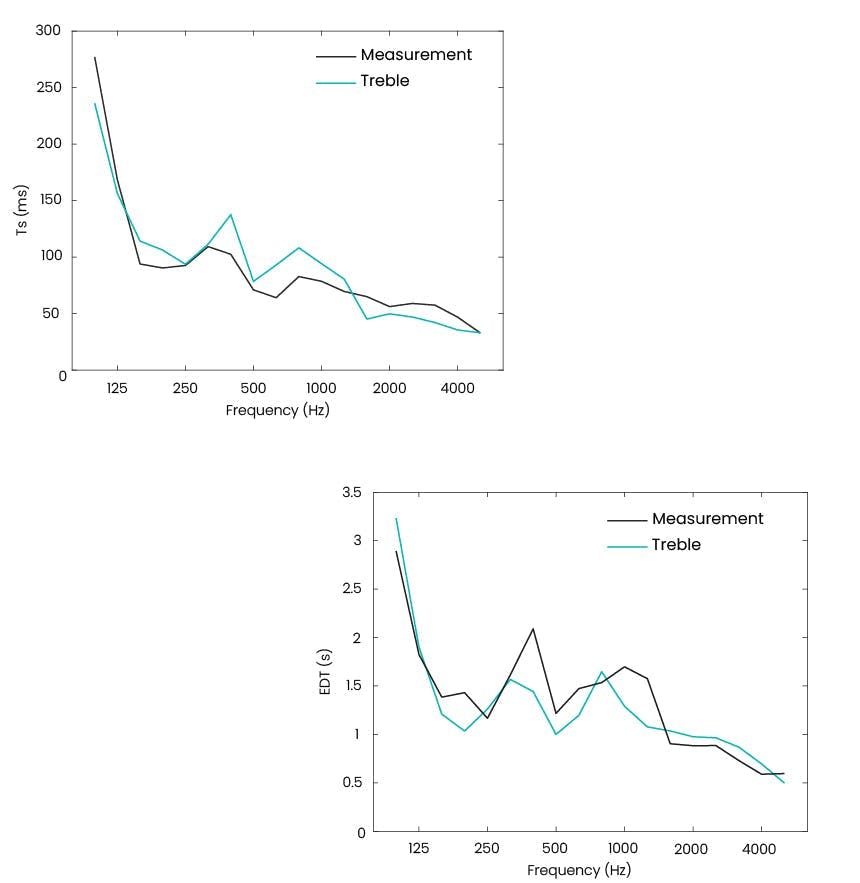
When a rectangular room is empty and has a porous ceiling absorber, the sound field becomes quasi-two-dimensional. This is because the vertical sound field decays faster than the horizontal sound field due to the absorption. As a result, the porous ceiling absorber cannot reduce the reverberation time effectively at low frequencies. This paper demonstrates how the sound field varies with two different porous layer configurations using both measurements and Treble simulations.

Key findings

  • Why higher absorption coefficients do not guarantee lower reverberation times.
  • How to avoid a highly imbalanced energy decay when improving the acoustics.
  • Are absorption coefficients are good input data for predictions of room acoustics.


This shows that Treble can account for interference by including the phase information. This is delightful news for room acoustic simulation  software users, as not many energy-based GA can do such accurate simulations.
Dr. Cheol-Ho Jeong
Associate Professor, Acoustic Technology
DTU

For more information about our technology, you can read our knowledge base.
For more information about the importance and future of acoustic engineering, read our insight paper.

You can also find more validation studies such as:
- Full bandwidth wave-based simulations using Treble

Recent posts

26 February 2026

Webinar: A new era for audio AI data

Join our webinar on February 26th unveiling new Treble SDK capabilities for advanced voice processing and audio AI, including dynamic scene simulation, a new source receiver device for own voice and echo cancellation scenarios and powerful tools for large scale synthetic data generation. Industry leaders in audio technology and voice AI will join to discuss how these advancements elevate product performance and accelerate research and development.
17 February 2026

The Next Major Evolution of the Treble SDK

The release is centered around two main areas. First, a substantial expansion of our device modeling capabilities. Second, a new framework for large scale data workflows and acoustic scene generation. Together, these changes further position the Treble SDK as a core infrastructure layer for modern audio algorithm development and virtual prototyping.
03 February 2026

Meet Treble at ISE 2026

We will be at ISE 2026 in Barcelona on February 3-6 where wewill showcase the Treble Web Application for high-fidelity room acoustic simulations, giving visitors a hands-on look at our streamlined cloud-based approach to acoustic prediction and auralization.