Yes. Treble lets you define microphone positions on your device and compare how different configurations affect the captured sound.
The Challenge
Smart glasses must deliver reliable audio as the wearer moves through constantly changing environments. With smart glasses, the wearer’s mouth sits close to the microphones, while the head, torso, frame geometry, and microphone placement all influence how sound is captured.
Unlike stationary devices, smart glasses move and turn with the wearer, continually changing their position relative to surrounding voices, noise, and reflections. Physical prototypes are slow and expensive to iterate, and real world recordings rarely cover the full range of conditions and edge cases needed to train and validate reliable audio systems.
How Treble Helps
Simulation driven smart glasses development
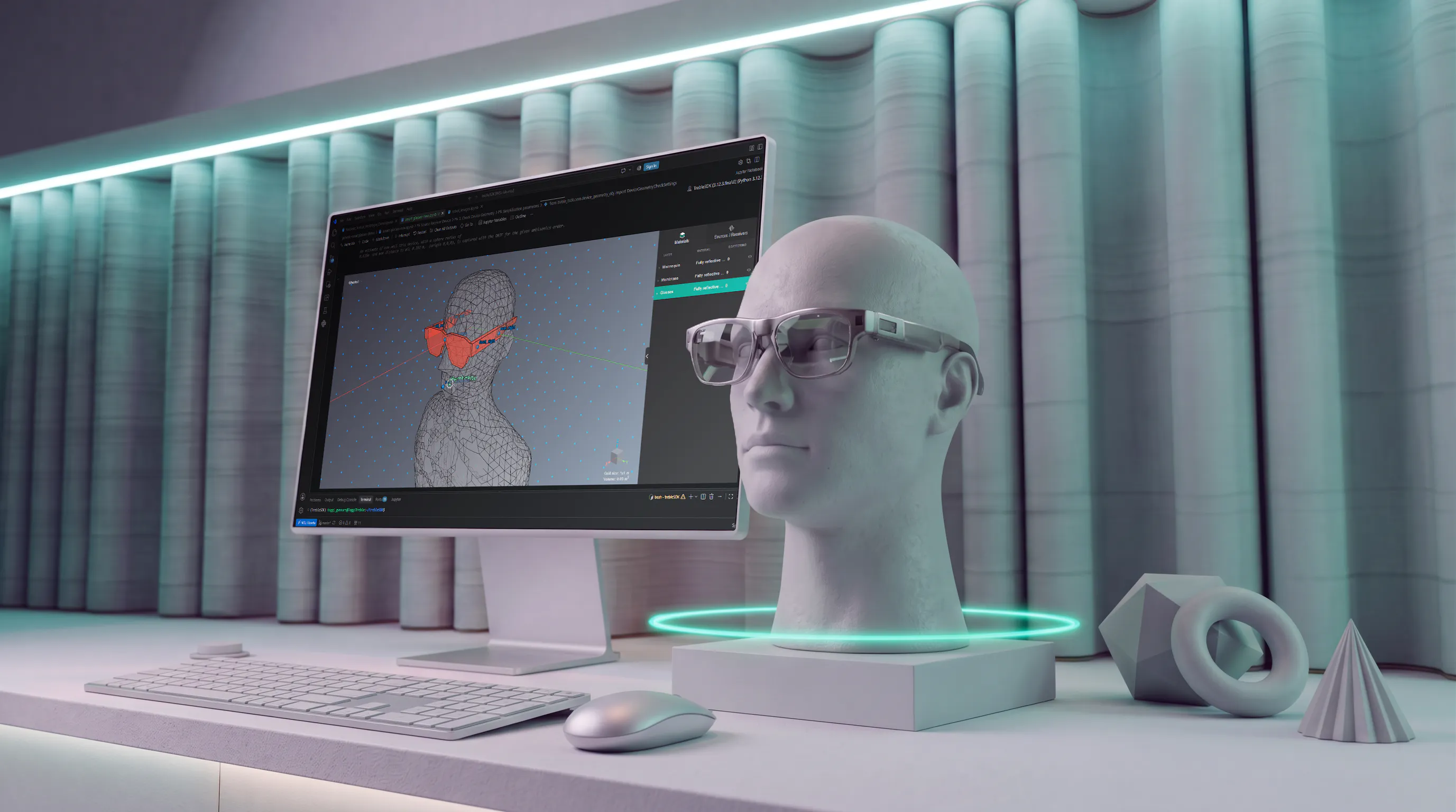
Treble lets you precisely model device and human geometries, explore microphone configurations, and simulate the acoustic path from the wearer’s mouth to each microphone—including how the head, torso, and glasses shape the sound.
Combine these device simulations with diverse acoustic environments to generate labelled training data, evaluate algorithms, and compare designs before committing to physical prototypes.
From microphone placement to real world speech performance.
Built for smart glasses audio development
Connect hardware design and speech AI development in one workflow. Treble helps engineering teams understand what each microphone captures, generate representative audio, and evaluate performance across controlled acoustic conditions.
Find the right microphone configuration.
Microphone Array Design
Explore how microphone placement and frame geometry affect acoustic performance. Compare small design changes through simulation to guide hardware decisions before building physical prototypes.
Accurately capture the wearer’s voice.
Wearer Voice Capture
Model sound travelling from the wearer’s mouth to each microphone, including near-field interactions and acoustic shadowing from the head and device. Develop and evaluate beamforming and speech enhancement systems with audio that reflects how the glasses are worn.
Train with audio that reflects your device.
Device Specific Training Data
Generate labelled audio datasets that account for your device geometry and microphone configuration. Vary rooms, reverberation, speech, and noise to train models across a wider range of listening conditions.
Find failure cases before deployment.
Real-World Acoustic Complexity
Test challenging edge cases with competing speakers, background noise, and complex reflections. Account for diffraction and acoustic shadowing that simplified simulations can miss, and identify where speech enhancement, separation, and recognition systems break down.
Purpose built for smart glasses workflows
Inside Treble
Better Design. Better Listening.
Lower Word Error Rate
0%
Lower source distance estimation error
0%
Lower source localization error
0%
Resources and validations
Improving multichannel speech enhancement through accurate room-acoustic simulations
Training on the high-fidelity dataset results in an up to 38% relative reduction in median word error rate compared to the lower-fidelity alternatives. These results show that augmentation with high-fidelity room-acoustic simulations directly translates into improved multichannel speech enhancement performance.

Synthesis of Room Acoustics for Speaker Distance Estimation
Explore how simulated acoustic data can support models that estimate a speaker’s distance from a microphone. This study presents a benchmark for generating room acoustics and evaluating their value for speaker distance estimation.
Room-Acoustic Simulations as an Alternative to Measurements for Audio-Algorithm Evaluation
Evaluate audio algorithms with simulated acoustic data. See how wave-based simulations closely match measured results.
Frequently Asked Questions
Yes. You can include head and device geometries and model the acoustic path from the wearer’s mouth to the microphones, including near-field interactions and head shadowing.
Yes. You can configure surrounding sound sources and vary their positions, orientations, and acoustic environments to create repeatable test scenarios.
Device specific audio can support training and evaluation for beamforming, speech enhancement, source separation, and speech recognition.